May 26, 2026
Angry at the sudden eviction of hawkers, Mamata Banerjee takes to social media to elaborate on established hawkers’ rights
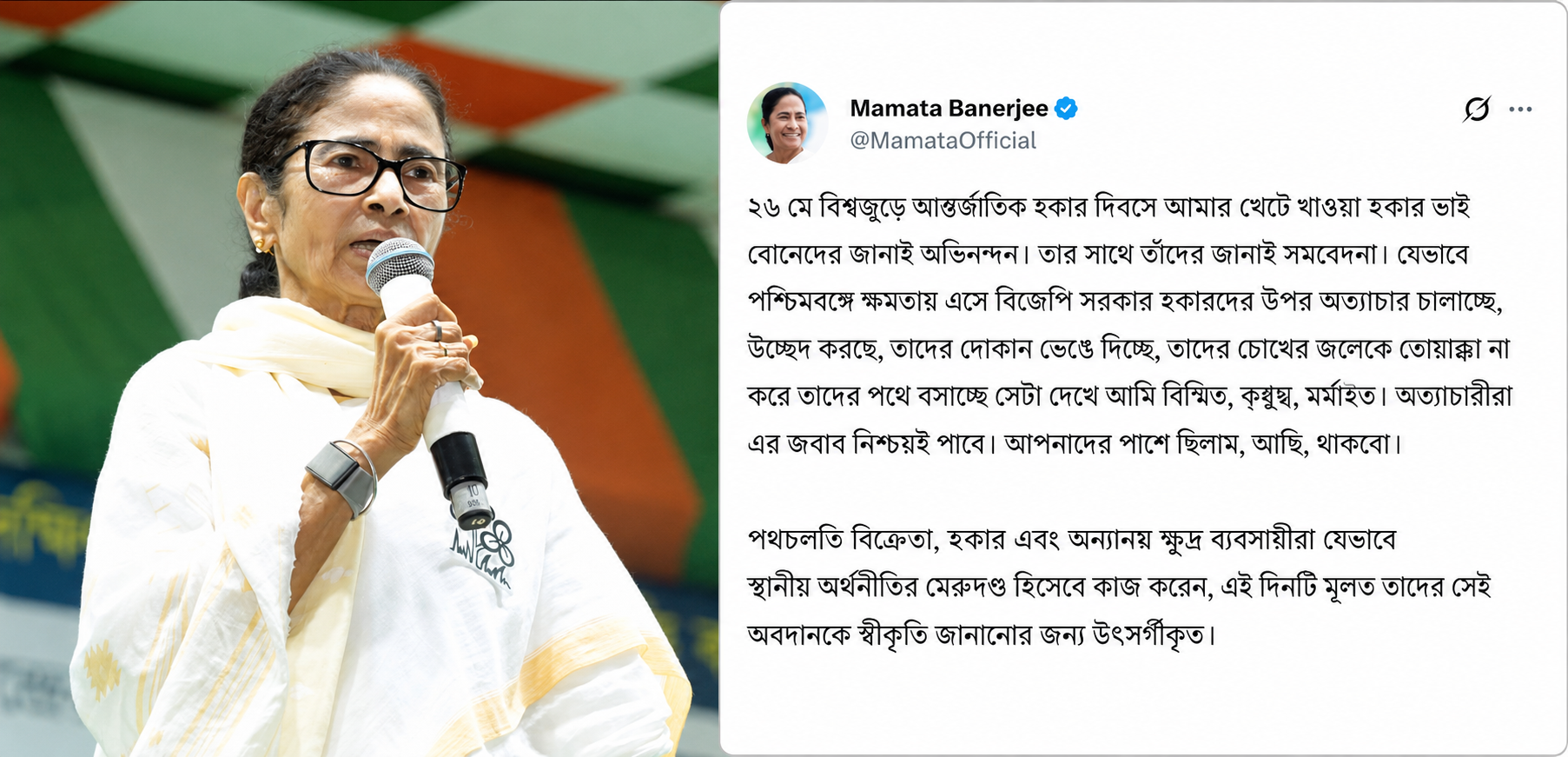
In a post on X on the occasion of International Hawkers Day on May 26, All India Trinamool Congress Chairperson and three-term chief minister of Bengal, Mamata Banerjee wrote (in Bengali) about how she was “astonished, angry, and deeply saddened” to see the BJP government “oppressing hawkers, evicting them, demolishing their stalls, and forcing them into destitution without any regard for their tears and suffering” immediately after coming to power in Bengal.
She said that the “oppressors will certainly be held accountable” and assured hawkers that she has always stood by them and will continue to do so in the future.
Mamata Banerjee gave a brief overview of the contribution of hawkers to the economy of the country, the laws to protect their rights and the landmark judgments of the Supreme Court that provided legal recognition to, and a framework for, hawkers’ rights.
She said that “street hawkers are the very symbol of grassroots economic activity”, providing “a vital link between large-scale production systems and the everyday needs of ordinary people” by being able to “deliver essential goods to people’s doorsteps at highly affordable prices”.
However, “maintaining this system always requires a delicate balance with urban planning considerations”, she said, thus bringing into focus the need for hawker management rather than hawker eviction.
The chairperson wrote that the informal sector has a huge role in “generating employment in developing countries” and that hawkers, who form an integral part of it, “provide a pathway to self-reliance for millions of people, enabling countless low-income families to earn a livelihood without depending on corporate or government jobs”.
She wrote how the Street Vendors (Protection of Livelihood and Regulation of Street Vending) Act was passed by Parliament in 2014 “[t]o balance the rights of pedestrians and permanent shopkeepers with the livelihood needs of hawkers”. The Act ensured “traffic congestion can be managed while also protecting hawkers from arbitrary eviction”.
Mamata Banerjee said that the goal of a well-planned city was not to eliminate hawkers but to integrate them into it by “establishing organised and well-equipped municipal markets”, which could ensure the preservation of both pedestrian safety and the vibrant small-scale urban economy.
She then wrote on how, over the past several decades, the Supreme Court, through a series of landmark judgments, “has provided legal recognition and a clear framework for hawkers’ rights”. “[T]he apex court has had to strike a balance between hawkers’ fundamental right to carry on a trade or profession under Article 19(1)(g) of the Constitution and the public’s right to clean and safe roads,” explained the chairperson, herself a trained lawyer.
She mentioned the cases of Bombay Hawkers’ Union vs. Bombay Municipal Corporation (1985), Sodan Singh vs New Delhi Municipal Committee (1989), Genda Ram vs Municipal Corporation of Delhi (2010) and Maharashtra Ekta Hawkers Union vs Municipal Corporation of Greater Mumbai (2013).
Through these judgments, Mamata Banerjee said, the Supreme Court established a clear legal doctrine that said:
1) Street hawkers have the right to livelihood, which meant that sudden or arbitrary eviction without conducting a survey or providing an opportunity for alternative arrangements constitutes a violation of Article 21 of the Constitution, which guarantees the right to life and livelihood, and
2) Regulation of hawkers’ rights must be carried out through democratic mechanisms such as town vending committees (TVCs), ensuring that hawkers’ own voices are reflected in urban planning and governance.