February 11, 2026
Saket Gokhale’s speech on the Union Budget for 2026-27
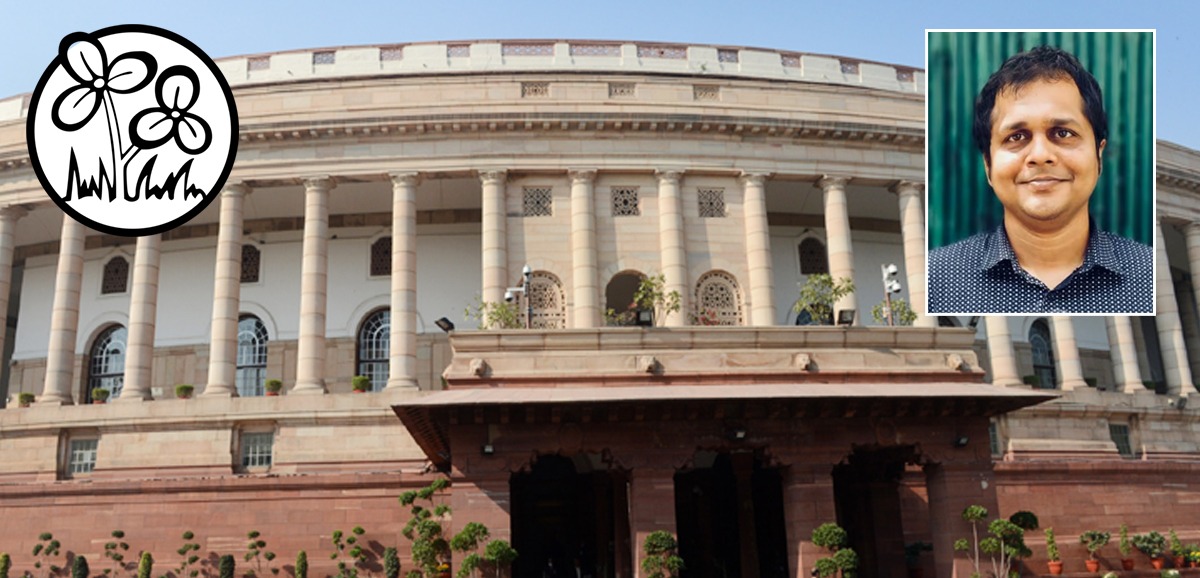
Mr. Deputy Chairman, Sir, I want to start by extending my gratitude to my Party, the All India Trinamool Congress and my leaders, Ms. Mamata Banerjee and Shri Abhishek Banerjee, for giving me a chance to speak on the Union Budget today. Sir, every time I have heard the previous speakers, right from the Prime Minister to all the other MPs from the Bharatiya Janata Party, I am reminded of a movie scene from the ’90s. सर, 1990 में एक पिक्चर आई थी। उसमें एक एक्टर था, जो एक पैर एक बाईक पर रखता था और दूसरा पैर दूसरी बाईक पर रखता था, and he is going around. So, the problem with the BJP is, इनका एक पैर 1947 में है and the other leg is in 2047; प्रेज़ेंट में कुछ भी नहीं है। They would either talk about what happened 50 years ago, or they are going to make us promises about 2047, which, as a Member before me, rightly said, we might be here to see, we might not be here to see. Sir, I am 39 years old now. During my teens and my early 20s, Mr. Vajpayee was the Prime Minister and later Dr. Manmohan Singh was the Prime Minister. There is a stark difference. And, I am saying this as a youth. The stark difference that I see is, at that time, policies mattered and not personalities. Today, our discourse has become purely personality-oriented. The Budget is personality-oriented, not policyoriented. That is a big problem. What happens is, when the Budget is guided by the vision of a person who should be in the margadarshak mandali, the youth are unable to relate to that Budget. This Budget has absolutely nothing as far as the young people of our country are concerned. Sir, there is a concept in America which used to be called ‘The Great American Dream’. That is how they say America came about to dominate the world over the last two centuries. It meant that every person, no matter where they come from, whatever their identity or religion, everyone could dream and they could make it big in America. That was the premise of it. Sir, I congratulate the Finance Minister because this is her ninth consecutive Budget. But, sadly, there is one question that has not been answered in any of these nine Budgets, including the current one. That question is: what is the great Indian dream? This Government has no vision for the great Indian dream. The problem is, the Government does not know the difference between dreams and delusions. The Government is suffering its own delusions and then it tries to pass those delusions as dreams, which you might, let us say, achieve in 2047. The problem is, this Government is also telling the young people of India that to dream is a crime. I would tell you how, Sir. The great Indian dream begins with education. That is what enables people to go ahead in life. Have you ever wondered why an increasing number of Indian students prefer to go abroad to study? I am not the one who says this. Look at countries around the world. We might be calling ourselves a Vishwaguru, but every country in the world is tightening its regulations on visa. Student visa numbers are being cut down, be it in the US, Canada or Australia. Why are students so desperate to leave the country? It is because the developed countries reward innovation and critical thinking. They encourage students to think of great ideas. They create ecosystems which enable students to explore their full potential and not just get a degree, but acquire the skills which would be valued in the job market. The problem is, our Indian universities today lack the atmosphere of innovation and research. We are not enabling our youth to think of new ideas. Sir, in this current Budget, higher education has been allocated Rs. 55,000 crores. Great! Shockingly, only 0.7 per cent of that is allocated for research and innovation. Today, if you look at the developed countries, some of the most cutting-edge start-ups are run by Indians, by Indian-origin people, a lot of them Indians who studied overseas and started their start-ups in those countries. So, why did these young Indians have to move abroad to study? They shouldn’t say, it happened before 2015. No degree goes on for 11 years! There are people who have been moving in the last 11 years. This is because our system does not give them the funds or the freedom to research and innovate. Sir, I will give you a comparison how much do other developed countries — we are going to go there in 2047, as the Prime Minister says — spend on research and innovation. The United States spends 6.34 per cent of their GDP. South Korea spends 4.96 per cent. Today, China’s economy is four times bigger than India and yet they spend 2.5 per cent of their GDP on research and innovation. We shamefully, in this Budget, are spending only 0.7 per cent. I will give an example, because we are a federal system. So, let us learn from our own States, forget South Korea, forget the United States. Under our Chief Minister, Ms. Mamata Banerjee, in West Bengal, year on year, our R&D Budget in this year, compared to last year, has grown by 17.6 per cent. Between last to this year, my Party’s Government in West Bengal, Mamata Banerjee’s Government, has increased R&D allocation by 17.6 per cent. That is how you respect the youth! That is how you show the youth that there is something for you in the Budget that the State is making. The great Indian dreams rise in our education system. The India Skills Report suggests that nearly 50 per cent of Indian graduates are not employable. This is precisely why we see young Indians with Engineering Degrees and Ph.Ds applying for the jobs, today, of peons and constables! But, this Government continues to be in denial about unemployment. Now, there can be only one thing that unemployment does not exist, as the Government claims. If that is the case, then, in Budget after Budget, you are announcing a new employment scheme, it fails and you forget it by the next Budget. If there is no unemployment, then, why are you coming up with unemployment schemes that are not working? If you are coming up with schemes, that clearly means that there is unemployment. This Budget ignores the other crucial aspect also, which is under-employment. We need to think not just about youth, who do not have jobs, but also about young people who are paid much less than they deserve. Today, the unemployment rate for youth in India is about 15 per cent. Of the remaining young people with jobs, 10 per cent are under-employed. This Budget ignores the burning problem that a quarter of India’s youth population does not have part-time or full-time jobs! What about the young people who have jobs? There is a Report called the ‘State of Work in India’ by Azim Premji University. It says that 34 per cent of Indian youth is paid less than what they deserve. The Government likes to tell us that we are the world’s fourth largest economy. But, what the Government does not tell people is, in terms of per capita GDP, our economy ranks at 123rd! This is not nominal; this is by Purchasing Power Parity. This means, in terms of purchasing power, an urban Indian youth is poorer than a young person even in war-ravaged countries like Iran, Iraq, Lebanon, Ukraine and Libya. Our youth are poorer than the youth in these countries. For the last 11 years, including in this Budget, the Government has never bothered to even consider the idea of quality of employment. We have heard numerous incidents over the last several years of young people dying at work due to stress, due to overworking and due to not having fixed hours. The truth is that most Indian employees, today, if you go out and ask, are overworked, underpaid and in constant fear of being laid off. Even the ones who have jobs are one day away from being laid off from their country. This Budget shows that young urban Indians, sadly, are not a ladla bhai or a ladla behen for this Government. They are just a source of taxes; take the money and use that for funding your election campaigns and giving freebies. That is the problem. A developed country does not necessarily mean the size of the economy. There are smaller economies than us who have a much better quality of life. When young Indians travel abroad, they are shocked to see that they can drink water straight from the tap. On the other hand, in Indian cities, people are forced to spend money on RO filters and Bisleri bottles just to drink clean water. The Government does not provide clean water. What they do is, they will impose GST on mineral water and your RO purifiers. The top 10 polluted cities in the world are in India. What does our Government, what does this Budget do about it? Nothing. But, they will impose an 18 per cent GST on air purifiers, if you decide to go and do something about the situation yourself. Today, quick commerce Apps have started providing ambulance services. That is the dismal state of our country. It is easier to get an ambulance on Blinkit than calling 108. You know, at least, on the App, the ambulance will come there. In this Budget, we are spending only 3 per cent of our GDP on healthcare. Let us compare this to viksit countries like UK, Germany, France and Japan, who spend 6 to 9 per cent of their GDP. We are spending 3 per cent! When young Indians pay sky high taxes, this Government does not even provide basic quality healthcare in return. When the Government forces people to purchase private medical insurance, the least they can do is allow tax reduction for the premium that they paid. Only when Ms. Mamata Banerjee wrote a letter, and a year-and-a-half after that, they decided to scrap the GST on medical insurance premium. In the Union Budget, the Government claims to be spending Rs.3.10 lakh crores on building roads and highways. Even after spending this amount by the Government, people are expected to pay a toll when they drive on the road. Despite paying taxes and despite paying a toll, when you get onto the roads, what is the quality of these roads? Every year, 1.7 lakh Indians die in road accidents. Which means, even after spending Rs.3.10 lakh crores and charging an exorbitant toll, 500 people, I repeat, Sir, 500 people die on Indian roads every day. What are we paying these taxes for? According to the Budget, the Government failed to spend 40 per cent of the money allocated for housing last year. Forty per cent of the housing Budget was not spent. Where does this leave young people? Today, if you go to any big Indian city, rents are unaffordable for the people. Then, people have to take creaky public transport or roads where they can die just to be able to commute to work. People have no time left for rest or leisure. About 30 per cent of an average urban Indian worker’s salary goes just into paying rent in the bigger cities. I have lived in several cities. I am from Bombay. I live in Delhi now. I have lived around the world and I have lived in Kolkata. I am proud of the fact and this House would be surprised to know that for a big city, with a growing economy, Kolkata still has the lowest rents in the country. Why? It is so because the Government does something about creating housing. The Government does something about creating affordable housing. This is another lesson that the hon. Finance Minister can learn from Ms. Mamata Banerjee. The Modi Government spent Rs.1.64 lakh crores on developing 100 Smart Cities. That Smart City project is now over. With hand on our heart, I am going to ask everyone, especially in the treasury benches: Please, can they stand in front of a group of 200 people in the age of 18 to 40 and tell them that we have 100 great quality Smart Cities in India? Will they really be able to say that this is the Smart City project that the Government spent Rs.1.64 lakh crores on? In conclusion, when the Finance Minister gives a reply, I want to ask her three questions, and I hope she replies to these. One, what does this Budget do in order to provide quality jobs for young urban Indians and to ensure a healthy work environment? Second, in terms of the delusional promise of Viksit Bharat, what does this Budget do in order to provide essentials like drinking water, affordable housing, clean air and good quality healthcare? And the third thing, what does this Budget have for the young urban Indians to explore their potential? In conclusion, all I want to say is that for the last 12 years, young Indians have suffered PM Modi’s dreams and delusions. Instead, young urban Indians are asking one question from the Budget – what and where is the ‘great Indian dream’? Thank you, Sir.